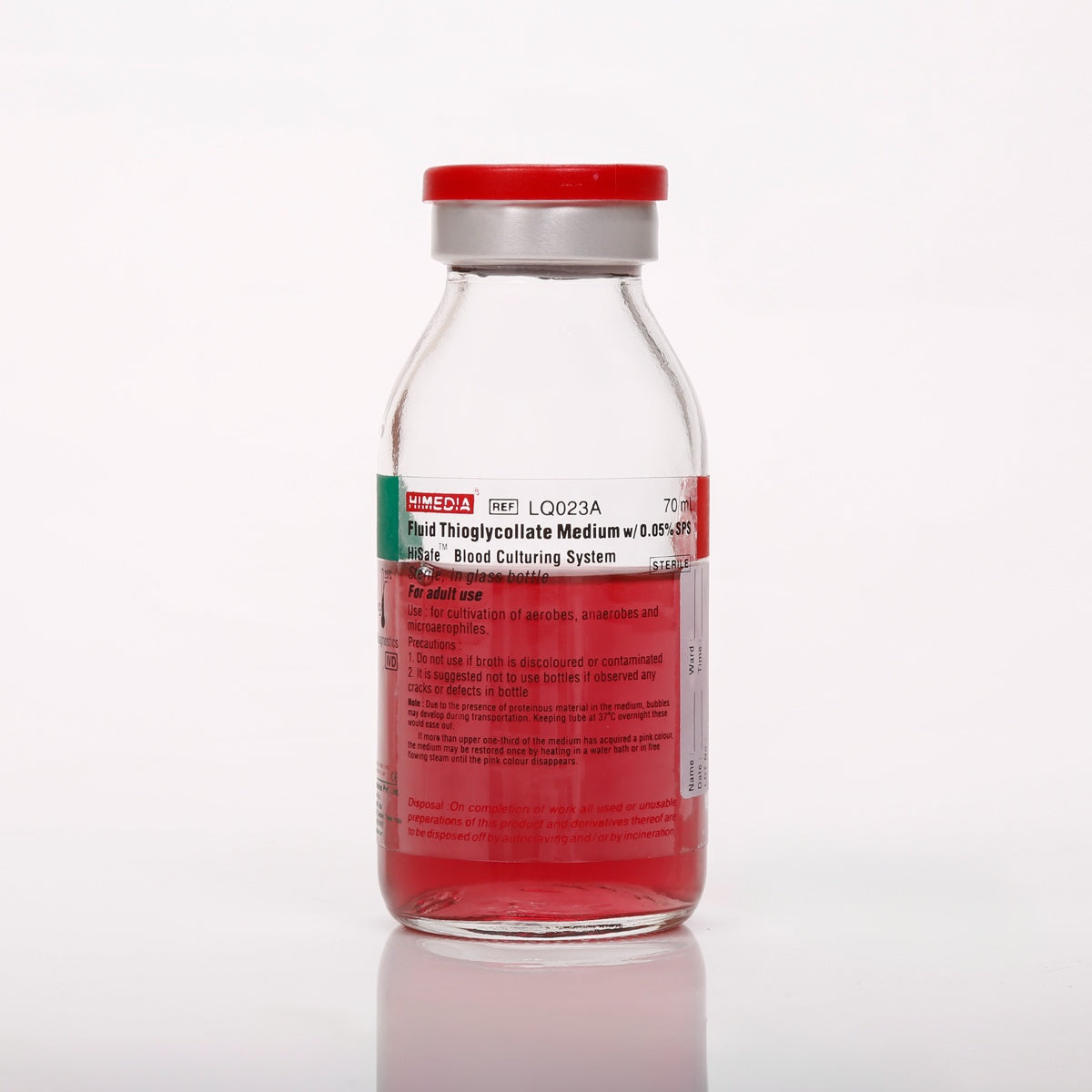
This medium is recommended for cultivation of aerobes, anaerobes and microaerophiles in blood culture. The medium contains resazurin dye. Small amount of Agar and L-cystine helps in creating anaerobic conditions. Sodium polyanetholesulfonate (SPS), an anticoagulant which inhibits the antimicrobial systems of blood, is used widely in blood culture medium and cause an increase in recovery of these organisms. It contains 70 ml medium for adult use.
Intended Use
Recommended for cultivation of aerobes, anaerobes and microaerophiles. Sterile, in glass bottles.
Composition
Ingredients g / L
Tryptone 15.000
Yeast extract 5.000
Dextrose (Glucose) 5.500
Sodium chloride 2.500
L-Cystine 0.500
Sodium thioglycollate 0.500
Resazurin sodium 0.001
Agar 0.750
SPS 0.500
Final pH (at 25°C) 7.1±0.2
**Formula adjusted, standardized to suit performance parameters
Directions
Label the ready to use blood culture bottle. Remove the Aluminium foil cap. Disinfect the part of the rubber stopper which is now exposed. Draw patient's blood with the sterile or disposable needle and syringe as explained in specimen collection and disposable column. Transfer the blood sample immediately into the culture bottle by puncturing the rubber stopper with the needle and injecting the blood. Venting: Use sterile venting needle (LA038). Keep the bottle in an upright position preferably in a biological safety cabinet, place an alcohol swab over the rubber stopper and insert the venting needle with filter through it. Insertion and withdrawal of the needle should be done in a straight line. discard the needle and mix the contents by gently inverting the bottle 2-3 times. Do Not vent the bottle for anaerobic cultures. Incubate at 35-37°C for 24-48 hours. and further for seven days.
Principle and Interpretation
Brewer (1) formulated Fluid Thioglycollate Medium for rapid cultivation of aerobes as well as anaerobes including microaerophiles by adding a reducing agent and small amount of agar. The USP (2), BP (3), EP (4) and AOAC (5) have recommended the media for sterility testing of antibiotics, biologicals and foods and for determining the phenol coefficient and sporicidal effect of disinfectants. However, it is intended for the examination of clear liquid or water-soluble materials. Fluid Thioglycollate Medium is also routinely used to check the sterility of stored blood in blood banks (6).
Dextrose, tryptone, yeast extract, L-Cystine provide the growth factors necessary for bacterial multiplication. L-Cystine and sodium thioglycollate allows Clostridium to grow in this medium even under aerobic conditions (7). Also the small amount of agar used in the medium favors the growth of aerobes as well as anaerobes in the medium, even if sodium thioglycollate is deleted from the medium (1). Sodium thioglycollate act as a reducing agent and neutralizes the toxic effects of mercurial preservatives and peroxides formed in the medium, thereby promoting anaerobiosis, and making the medium suitable to test materials containing heavy metals. (8,9). Any increase in the oxygen content is indicated by a colour change of redox indicator, resazurin to red (10). The small amount of agar helps in maintaining low redox potential for stabilizing the medium (9). SPS (Sodium polyanethol sulphonate, SPS) is used as a nontoxic anticoagulant which enables bacterial growth and prevents the action of natural bacterial inhibitors of blood. Van Haebler and Miles (11) first demonstrated the usefulness of SPS in Blood culture medium.
Note: If more than upper one-third of the medium has acquired a pink-purple colour, the medium may be restored once by heating in a water bath or in free flowing steam until the pink colour disappears.
Type of Specimen
Clinical samples- blood samples.
Specimen Collection and Handling
For clinical samples follow appropriate techniques for handling specimens as per established guidelines (12,13).
Warning and Precautions
In Vitro diagnostic use. For professional use only. Read the label before opening the container. Wear protective gloves/ protective clothing/eye protection/face protection. Follow good microbiological lab practices while handling specimens and culture. Standard precautions as per established guidelines should be followed while handling clinical specimens. Safety guidelines may be referred in individual safety data sheets.
Limitations
It is intended for the examination of clear liquid or water-soluble materials.
Performance and Evaluation
Performance of the medium is expected when used as per the direction on the label within the expiry period when stored at recommended temperature.
Quality Control
Appearance: Sterile clear Fluid Thioglycollate Medium w/ 0.05% SPS in glass bottle.
Colour: Light straw coloured solution with upper 10% or less medium pink-purple on standing.
Quantity of Medium: 70ml of medium in glass bottle, (For Adult use)
pH: 6.90-7.30
Sterility Check: Passes release criteria
Cultural response: Cultural characteristics was observed after incubation at 35-37°C for 24-48 hours for bacteria and at 22-28°C for fungus for 48-72 hours
Organism Inoculum (CFU) Growth
Candida albicans ATCC 10231 (00054*) 50-100 luxuriant
# Bacillus spizizenii ATCC 6633 (00003*) 50-100 luxuriant
Streptococcus pyogenes ATCC 19615 50-100 luxuriant
Neisseria meningitidis ATCC 13090 50-100 luxuriant
Clostridium sporogenes ATCC 11437 50-100 luxuriant
Micrococcus luteus ATCC 10240 50-100 luxuriant
Key: *Corresponding WDCM numbers. # - Formerly known as Bacillus subtilis subsp. spizizenii
Storage and Shelf Life
Store between 15-30°C. Use before expiry date on the label. Product performance is best if used within stated expiry period.
Disposal
User must ensure safe disposal by autoclaving and/or incineration of used or unusable preparations of this product. Follow established laboratory procedures in disposing of infectious materials and material that comes into contact with clinical sample must be decontaminated and disposed of in accordance with current laboratory techniques (12,13).
Safety data sheet(SDS)